Where does Ron’s Amazing Stories get its great stories? Where do we get our great guests? In this blog I will tell you all my secrets, well some of them anyway, of how we get our content. So sit back, put on your reading glasses and learn something new.
Where do the great stories come from?
We have talked about this before. The RAS would not be here today if not for the Internet Archive. It is a non-profit library of millions of free books, movies, software, music, and much more. If it exists or ever existed it will be on this archive. They are a profit free organization that has the goal of persevering our history. I love these guys!
Another service I use is tied to the internet archive. LibriVox.org audiobooks are free for anyone to listen to on their computers, iPods, other mobile devices, or even to burn a CD. They take materials in the public domain and read it to you. These guys have it all from Homer to Shakespeare, Asimov to Chekov. Their library is amazing!
Where do the great guests come from?
Some of the folks we interview on the show contact us directly using the main website, others I research and go after them myself. However, I would be remiss if I did not thank the people of Radio Guest Lists. They run a truly amazing service that allows podcasters like me to connect with folks who want to heard. Authors, Musicians, Comedians and many others use this service to promote their work. I am here to tell you that it works! If you are looking for experts or guests for a show, start here you can not go wrong.
That all I have for this Blog. I hope you enjoyed this behind the scenes look at Ron’s Amazing Stories.
-Ron
This Week’s Podcast:
On the podcast this week you can expect a suspenseful show. Who are those ants and do they do birthday parties? Also, we get to the bottom of the dead guy in the chair. You want more? Well tune in this Thursday and listen to Ron’s Amazing Stories. You can listen to this podcast this Thursday at Ron’s Amazing Stories, download it from iTunes, stream it on TuneIn Radio or listen on your radio Friday night at 8pm Eastern time. Check your local listing or find the station closest to you at this link.
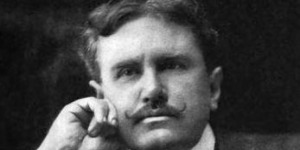
Who was O. Henry? His real name was William Sydney Porter and he was an American author of hundreds of short stories. He was born September 11th, 1862 in Greensboro, North Carolina, to physician Algernon Sidney Porter and Mary Jane Virginia Swaim. He had two brothers Shirley and David who both died in early childhood. His father was a gentle and good humored man and his mother an artist and poet.
At the age of fifteen O. Henry began working as a clerk in his uncle’s store, which was a combined pharmacy, soda fountain, tobacco shop, and newsstand. Porter became immersed in the social scene, entertaining the customers with stories and drawing cartoons of them for which he became well known. He saw the humor in the everyday, and made notes of all the colorful characters he encountered, which would become fodder for his future stories.
This is cropped the famous picture called, “O Henry The Critic”
After spending time in the Honduras, during which Porter coined the term “banana republic“, he had to return to Texas to face charges of embezzlement. In 1898 he began a five-year sentence in Columbus, Ohio federal prison. In 1899, from prison, Porter began his short story career. A number of his stories written in prison appeared in print, always under a pseudonym, his favorite being “O. Henry”. After being released from prison in just three years, Porter moved to New York City. This was where he really came into his own.
Porter lived an extravagant lifestyle amid increasing pressure to keep his commitments to publishers for more and more stories. This stress plus ill-health and heavy drinking led his death of liver failure on June 5th, 1910. He now lies buried at the Riverside Cemetery in Asheville, North Carolina. His last complete short story was “Let Me Feel Your Pulse“.
This Week’s Podcast:
On the show this Thursday we have mysteries to solve. Sherlock Holmes deals with a Locked room. O Henry searches around town and we have the explained tale from June. To learn more you just going to have to tune in and hear it for yourself.
You can listen to this podcast this Thursday at Ron’s Amazing Stories, download it from iTunes, stream it on TuneIn Radio or listen on your radio Friday night at 8pm Eastern time. Check your local listing or find the station closest to you at this link.
In this blog we talk about the five story types. Throughout history and across the globe every known society has produced stories. Whether it is told around a campfire in a primeval jungle or in a bus bound for Portland, we have told tales to keep our culture strong. In our current society the resources we dedicate to storytelling is astronomical. Think about how much time, money and effort is spent on movies alone. Tales are truly central to our lives.
In the book The Seven Basic Plots, Christopher Booker outlines what makes up a good story. Booker suggests that all successful stories utilize at least one of seven basic plots. What I will do in this blog is summarize what Chris has to say about each type. However, I do suggest reading his book for all the details. It is a great source for editors and novelist alike. The seven basic plots are:
Jaws was a 1970s mega hit and perfectly represents the Man Verses Monster plot line.
Overcoming The Monster – One great example of this is Jaws, the famous Steven Spielberg film of the 1970s. Spielberg’s enduring shark-tale addresses many of the key factors that make monsters, well, monsters. Numerous other examples of this basic plot type are found in myths, folklore, fairy tales, religion and film. Again and again, in different forms man is forced to face his demons and overcome the odds to kill beast.
The Rags to Riches Tale – This one really needs no explanation. However, if you think about it this is very similar to the overcoming the monster. The lack of money is the beast and it is killed when the main character makes good. This simple plot is used through all known history and cultures. After all who did not cheer for Cinderella when she finally got her prince charming?
The Quest – This is my personal favorite. The best example I can come up is J.R.R. Tolkien’s Lord of the Rings. The idea of man searching for answers and doing what it takes makes for great storytelling. We have seen this being used for thousands of years to create stories that are as fascinating to us as they were to our ancestors.
Voyage and Return – While almost Identical to the quest it differs in one important way. The quest takes you from point A to point B and resolves itself. In this plot type the main character makes a journey only to find out that he must return to beginning and face whatever it was he was running from. Homer’s Odyssey is a prime example of this and gives credibility to the ageless ability of tales to be told, retold and kept for generations. The poem mainly centers on the Greek hero Odysseus (or Ulysses, as he was known in Roman myths) and his long journey home following the fall of Troy.
Mel Brooks classic comedy where Robin discovers who he truly is. A very silly man who wears tights.
Comedy – Stories of this type are highlighted by misunderstandings, mistaken identities, and disguises. Only in the end are the true identities of the characters and their intentions revealed. I have never been a big fan of the comedy. I will admit though in literature it does have its place. Finding examples of this is not hard to do at all. I guess if I had to pick I would go with a movie that I watched quite recently. Mel Brook’s smash hit, Robin Hood: Men in Tights. Very funny stuff and it follows the characteristics of this plot type to a T.
Tragedy – Who doesn’t love a good tear jerker once in awhile? Shakespeare’s Macbeth or Romeo and Juliet are two of the best examples of this. We see this plot type being used again and again in so many different ways. I think we like to hear about the trials and troubles of others so we can say, “Well at least I didn’t get poisoned or run trough with a saber”.
Rebirth – Again this is one of my favorites. This plot type is best illustrated in A Christmas Carol by Charles Dickens. An evil man gets a second chance in life and makes the most of it. Stories of hope, change and rebirth are a cornerstone in our storytelling.
What these fundamental plot types share in common is that it’s all about human development and what is involved in becoming a mature person. Go back and read each one again. This time think about times in your own life where this plot line was used. I’ll bet you have a story for it. Hence, why we are here and how we became who we are.
This Week’s Podcast:
On the podcast this week we fulfill a request for a O-Henry story, have a cool tale from Jason Orr and play one of Ron’s all time favorites, all in one show. Sound amazing? That’s because it is Ron’s Amazing Stories!
You can listen to this podcast this Thursday at Ron’s Amazing Stories, download it from iTunes, stream it on TuneIn Radio or listen on your radio Friday night at 8pm Eastern time. Check your local listing or find the station closest to you at this link.
The Calendar:
February 25, 2016 – Them! (RAS234)
March 03, 2016 – The Ransom Of Red Chief (RAS235)
March 10,2016 – (RAS236)
March 17,2016 – (RAS237)
March 24,2016 – (RAS238)
March 31,2016 – (RAS239)
Articles Origin: This article is a reprint and was copied from The History Channel. The author is listed as History.com/Staff. It was published by A+E Networks in 2010 under the title of Presidents day and they hold the copyrights to its content.
Presidents’ Day is an American holiday celebrated on the third Monday in February. Originally established in 1885 in recognition of President George Washington, it is still officially called “Washington’s Birthday” by the federal government. Traditionally celebrated on February 22—Washington’s actual day of birth—the holiday became popularly known as Presidents’ Day after it was moved as part of 1971’s Uniform Monday Holiday Act, an attempt to create more three-day weekends for the nation’s workers. While several states still have individual holidays honoring the birthdays of Washington, Abraham Lincoln and other figures, Presidents’ Day is now popularly viewed as a day to celebrate all U.S. presidents past and present.
PRESIDENTS DAY: ORIGIN AS WASHINGTON’S BIRTHDAY
George Washington’s famous painting which hangs today in the Whitehouse.
The story of Presidents’ Day date begins in 1800. Following President George Washington’s death in 1799, his February 22 birthday became a perennial day of remembrance. At the time, Washington was venerated as the most important figure in American history, and events like the 1832 centennial of his birth and the start of construction of the Washington Monument in 1848 were cause for national celebration.
Did You Know?
President’s Day never falls on the actual birthday of any American president. Four chief executives—George Washington, William Henry Harrison, Abraham Lincoln and Ronald Reagan were born in February, but their birthdays all come either too early or late to coincide with Presidents’ Day, which is always celebrated on the third Monday of the month.
While Washington’s Birthday was an unofficial observance for most of the 1800s, it was not until the late 1870s that it became a federal holiday. Senator Steven Wallace Dorsey of Arkansas was the first to propose the measure, and in 1879 President Rutherford B. Hayes signed it into law. The holiday initially only applied to the District of Columbia, but in 1885 it was expanded to the whole country. At the time, Washington’s Birthday joined four other nationally recognized federal bank holidays—Christmas Day, New Year’s Day, Independence Day and Thanksgiving—and was the first to celebrate the life of an individual American. Martin Luther King Jr. Day, signed into law in 1983, would be the second.
PRESIDENTS DAY: TRANSFORMATION
If you take a close look at this photo of Lincoln you should see a couple of flaws
While Nixon’s order plainly called the newly placed holiday Washington’s Birthday, it was not long before the shift to Presidents’ Day began. The move away from February 22 led many to believe that the new date was intended to honor both Washington and Abraham Lincoln, as it now fell between their two birthdays. Marketers soon jumped at the opportunity to play up the three-day weekend with sales, and “Presidents’ Day” bargains were advertised at stores around the country.
By the mid-1980s Washington’s Birthday was known to many Americans as Presidents’ Day. This shift had solidified in the early 2000s, by which time as many as half the 50 states had changed the holiday’s name to Presidents’ Day on their calendars. Some states have even chosen to customize the holiday by adding new figures to the celebration. Arkansas, for instance, celebrates Washington as well as civil rights activist Daisy Gatson Bates. Alabama, meanwhile, uses Presidents’ Day to commemorate Washington and Thomas Jefferson (who was born in April).
Washington and Lincoln still remain the two most recognized leaders, but Presidents’ Day is now popularly seen as a day to recognize the lives and achievements of all of America’s chief executives. Some lawmakers have objected to this view, arguing that grouping George Washington and Abraham Lincoln together with less successful presidents minimizes their legacies. Congressional measures to restore Washington and Lincoln’s individual birthdays were proposed during the early 2000s, but all failed to gain much attention. For its part, the federal government has held fast to the original incarnation of the holiday as a celebration of the country’s first president. The third Monday in February is still listed on official calendars as Washington’s Birthday.
PRESIDENTS DAY: CELEBRATIONS AND TRADITIONS
Like Independence Day, Presidents’ Day is traditionally viewed as a time of patriotic celebration and remembrance. In its original incarnation as Washington’s Birthday, the holiday gained special meaning during the difficulties of the Great Depression, when portraits of George Washington often graced the front pages of newspapers and magazines every February 22. In 1932 the date was used to reinstate the Purple Heart, a military decoration originally created by George Washington to honor soldiers killed or wounded while serving in the armed forces. Patriotic groups and the Boy Scouts of America also held celebrations on the day, and in 1938 some 5,000 people attended mass at Saint Patrick’s Cathedral in New York City in honor of Washington.
In its modern form, Presidents’ Day is used by many patriotic and historical groups as a date for staging celebrations, reenactments and other events. A number of states also require that their public schools spend the days leading up to Presidents’ Day teaching students about the accomplishments of the presidents, often with a focus on the lives of Washington and Lincoln.
Articles Origin: This article is a reprint and was copied from The History Channel. The author is listed as History.com/Staff. It was published by A+E Networks in 2010 under the title of Presidents day and they hold the copyrights to its content.
This Week’s Podcast:
This week’s podcast is dedicated to the past and present presidents of the USA. On the program you will hear a very special speech from one of our most famous presidents. Also I found a little known OTR series called “Mister President”. We round the show out with story from Mark Twain. Sounds good to me, I hope you come and listen to it.
You can listen to this podcast this Thursday (12/03) at Ron’s Amazing Stories, download it from iTunes, stream it on TuneIn Radio or listen on your radio Friday night at 8pm Eastern time. Check your local listing or find the station closest to you at this link.
“The first step to believing something is true is wanting to believe it is true… or being afraid it is”. – Terry Goodkind
Today folks sit around the TV watching Sleepy Hallow, The Walking Dead or Supernatural to get terrified. Some even think with the arrival of TV came the advent of horror. This could not be further from the truth. Before TV, there was radio and it did a pretty good job of making folks run into the night to hide in themselves in bunkers of doom. You only have to go back to 1938, on a certain Halloween night, to learn all about this. Yes, much of early radio was made up of comedies or dramas, just like television programs today, but there were also shows dedicated to the macabre — they made goosebumps rise and sent shivers down the spine. It’s has been often said that what you can’t see is scarier than what you can. Old time radio exceled in this. They created a comprehensive spooky world right inside your own head.
We have played many of these wonderful stories on Ron’s Amazing Stories. Shows for series like Suspense, Lights Out, Quiet Please, The Mysterious Traveler and many others. We have had guests come on the show to talk about the subject. A short list of these can found at this link. Of course the granddaddy of them all is the second podcast I do with Jason Dowd, The Horror Express. This one is dedicated to all things horror.
I leave you with a quote from Stephen King. His thoughts on horror are summed up by saying, “We make up horrors to help us cope with the real ones.” I fear this is very true.
This Week’s Podcast:
On the show this week we have a ghost that steals pants, ghosts that decide the fate of a kingdom and finally a short email about helpful ghost that protects and serves. So tune in this Thursday to hear all about it
You can listen to this podcast this Thursday (12/03) at Ron’s Amazing Stories, download it from iTunes, stream it on TuneIn Radio or listen on your radio Friday night at 8pm Eastern time. Check your local listing or find the station closest to you at this link.



 Ron's Amazing Stories - The Blog